
Author: Eric Celidonio
Agency recruiters can be powerful allies to jobseekers – but their role is often fundamentally misunderstood. To work with one effectively and set realistic expectations for the partnership, it’s crucial to understand the basics of how they operate.
First, a reality check: agency recruiters work for the hiring company, not for you. Their fee comes from the client, who hires them to fill a specific role. Their mission is to deliver the best possible candidate for that position as quickly and efficiently as possible. If you’re among the top talent in a hot segment, a recruiter may actively market your profile to their clients, but if you’re not a close match for their current searches, you may not be prioritized for those roles.
Agency recruiters can’t help every job seeker
- They work within a specific domain. Many specialize in clearly defined areas (e.g., bioinformatics, clinical development) and are tasked with finding only top-tier candidates for which their client will be willing to pay a fee.
- They vary in depth of understanding about the industry. Even experienced recruiters may not hold expertise in every niche or technical specialty within the field.
- First impressions can be make or break. Communication style, professionalism, and perceived fit can outweigh raw credentials when trying to narrow down candidates from a long list to present the client.
- Time is limited. Recruiters are often tasked with juggling multiple searches, and their busy schedules can’t often accommodate ongoing career coaching.
- Bias exists. Like hiring managers, recruiters are human and can therefore be influenced by subconscious preferences. However, they’re not the final decision-makers – they act as proxies, submitting a curated list of candidates to the client. Because the client is paying a fee, they expect a very tight fit and a highly competitive level of experience from those they receive, so even qualified candidates may be passed over if they don’t align closely with the client’s brief.
- Feedback may be minimal. If you’re not shortlisted, you might not receive detailed notes – often due to time constraints or legal considerations
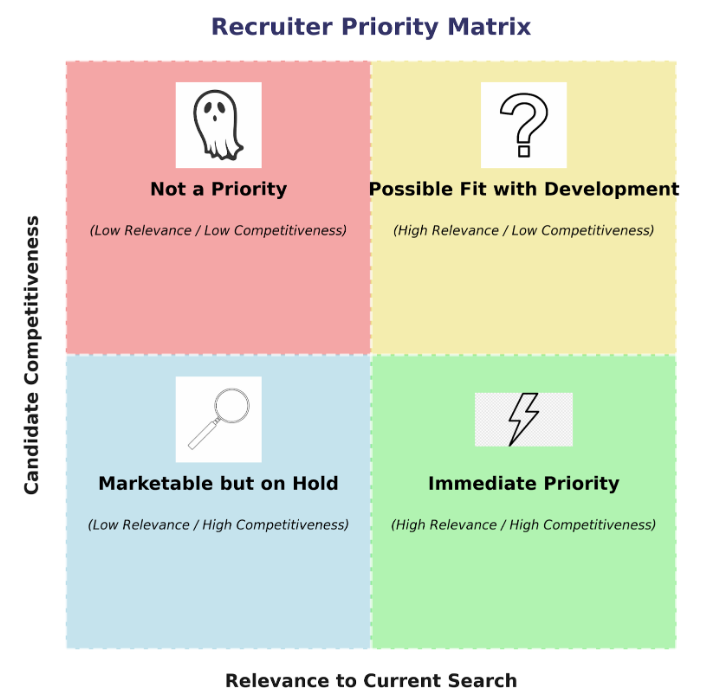
The Recruiter Priority Matrix
To better understand how recruiters decide who gets their immediate attention, think of it as a two-axis matrix:
- X-axis: Relevance to the recruiter’s current search
- Y-axis: Candidate competitiveness (skills, experience, and marketability)
Only candidates in the top-right quadrant – high relevance and high competitiveness – are immediate priorities.
- Top right: Immediate Priority – Skilled, competitive, and directly relevant to an active search.
- Top left: Marketable but on Hold – Strong candidate but not aligned to current roles.
- Bottom right: Possible Fit with Development – Relevant but not competitive enough yet.
- Bottom left: Not a Priority – Neither aligned nor competitive for current needs.
Your goal is to position yourself in that top-right quadrant whenever you approach a recruiter.
What an agency recruiter can do for you
When you’re a strong match for one of their roles, the right recruiter can be a game-changer:
- They can connect you to unadvertised opportunities in their network.
- They can advocate directly to hiring managers on your behalf.
- They might share insider insights on company culture, compensation norms, and decision-makers.
- They will negotiate offers to help you secure the best package.
There’s a huge advantage in having someone else tell your story in a persuasive, targeted way. Self-promotion can feel awkward – but when a recruiter does it for you, it takes away some of that discomfort, and it can be a powerful tool.
How to get the most out of the relationship
The best recruiters are approachable, engaging, and ask the right questions to understand their candidates – but they are not your career coach. They don’t have the bandwidth to explore every “what’s next” idea, or to unpack your entire professional history over coffee – that’s where a career coach comes in.
If you want to work effectively with an agency recruiter:
- Be professionally visible. Connect on LinkedIn, attend industry events, and keep your network active.
- Be clear on your goals. Know what you want out of your next role and be able to articulate it concisely.
- Lead with your value. Highlight your key strengths, notable achievements, and what sets you apart from other candidates going for the same roles.
- Frame your story professionally. Share your reason for seeking a new position in a way that is both honest and reflects well on you.
- Treat them like a potential hiring manager. Every interaction is a chance to show you’d represent them well with their client – treat them as such!
Even if you’ve known a recruiter for years, treat every touchpoint as an opportunity to update them on your skills and accomplishments. The candidates who approach recruiters with focus, professionalism, and a clear value proposition are the ones who get put forward – and hired.
Here at Sci.bio, we work with a variety of candidates from new graduates to experienced executives, and have myriad open roles. We pride ourselves on connecting our highly discerning clients with candidates who fit their specific needs. Check out our job search page to see current openings and follow us on LinkedIn for more information.